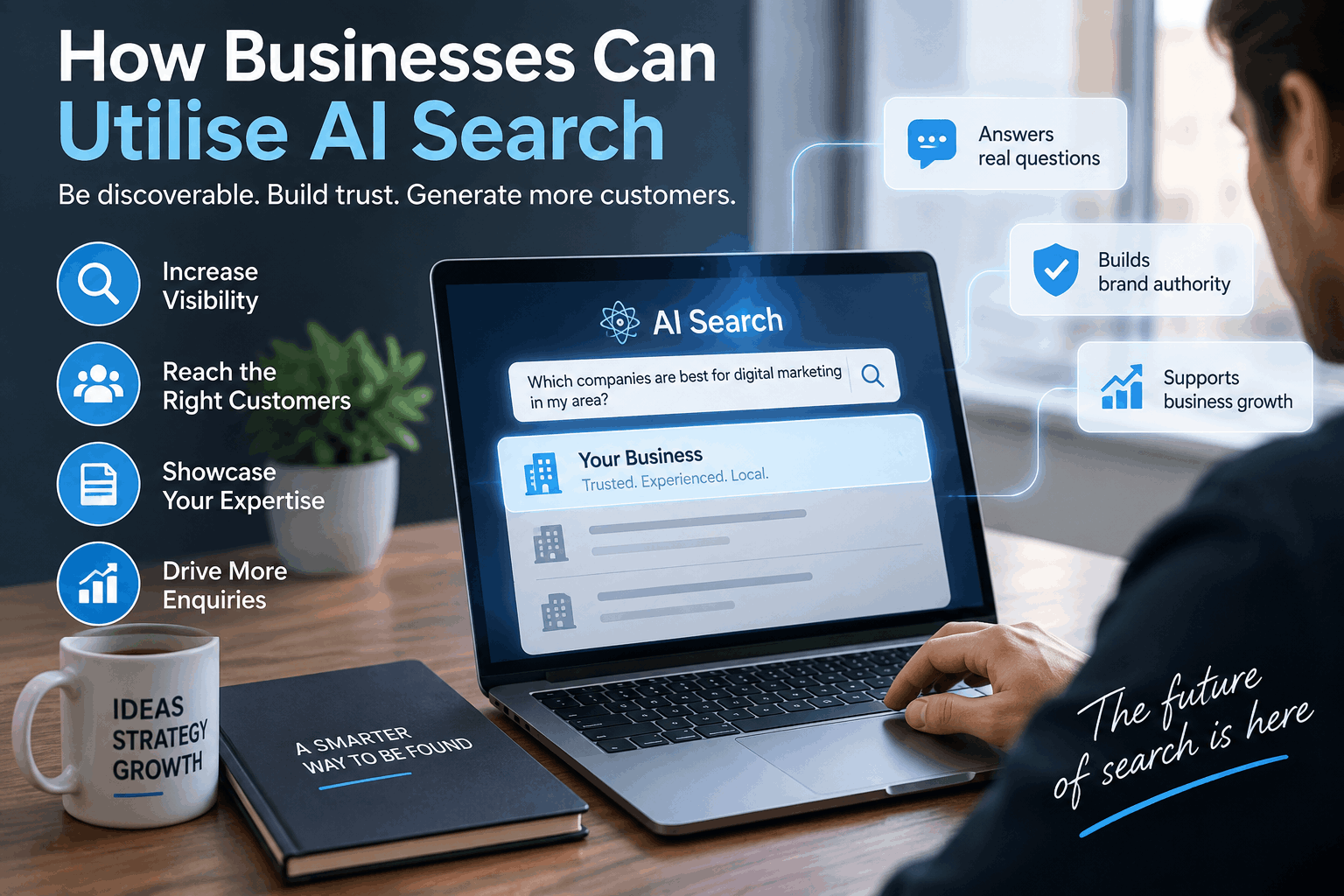
How Businesses Can Utilise AI Search to Improve Visibility and Win More Customers
The way people search online is changing. Traditional search engines still play a major role, but more users are now asking detailed questions through AI-powered search tools and assistants. Instead of typing a short phrase and opening several websites, people can ask for recommendations, comparisons, explanations and buying advice in a conversational format.
For businesses, How Businesses Can Utilise AI Search is becoming an increasingly important question. AI search can influence which companies are discovered, which brands are mentioned and which sources are used when customers research products or services. Businesses that make their expertise easy to understand and verify may be better positioned to appear within these new search experiences.
This shift does not mean conventional SEO is becoming irrelevant. Strong technical SEO, useful content, backlinks, brand authority and accurate business information remain important. In many cases, these same signals can also help AI systems understand what a company does and whether it is relevant to a user’s question.
The key difference is that businesses now need to think beyond individual keywords and conventional rankings. AI search is often driven by natural-language questions. A potential customer may ask, “Which company is best for commercial roofing in my area?” or “What should I look for when choosing an energy consultancy?” rather than entering a short search phrase.
That means businesses need to create content that answers real customer questions clearly and usefully.
Create Content That AI Search Can Understand
One of the most effective ways businesses can adapt is by creating high-quality content around the questions customers ask before making a decision.
This may include service guides, FAQs, comparisons, case studies, pricing information and educational articles. The objective should be to answer the question properly rather than simply repeating a keyword.
A company offering commercial cleaning services, for example, could create content explaining how often offices should be cleaned, what affects cleaning costs, what is normally included in a contract and how businesses should compare providers.
A software company could answer questions about implementation times, integration, security, pricing structures and whether a particular solution is suitable for different types of organisation.
This type of content gives both customers and search systems more context.
Clear structure also helps. Pages should explain the subject directly, use descriptive headings and avoid filling the opening paragraphs with vague marketing language. Important answers should appear reasonably early on the page.
Businesses should also demonstrate expertise rather than simply claiming it. Specific examples, data, case studies and practical explanations can make content more credible.
Original information is particularly valuable. Most companies possess knowledge that is not easily copied from competitors. This might include project experience, customer questions, internal research, performance data or specialist knowledge from employees.
Turning that information into useful content can help differentiate the business.
Strengthen Brand Authority Across the Web
AI search does not rely solely on what a company says about itself.
Independent signals can also matter. If a business is repeatedly mentioned by credible industry websites, directories, trade organisations, news publications and customers, there is more information available to support the relationship between that company and its area of expertise.
This is one reason digital PR and quality link building remain important.
Businesses should focus on earning relevant mentions rather than collecting large numbers of low-value links. A reference from an authoritative industry publication is generally more meaningful than dozens of links from unrelated or poor-quality websites.
Reviews can also contribute to the wider picture of a business. Genuine customer reviews help prospective customers understand what a company is like to work with and provide independent information about its services.
Consistency matters as well. The business name, location, services and contact information should be accurate across important online sources.
If one website describes a company as a software consultancy while another presents it as an IT reseller and a third contains outdated contact information, the overall picture becomes less clear.
Businesses should therefore think about entity consistency: making sure search engines and AI systems can confidently understand who the organisation is, what it provides and where it operates.
This applies to local businesses too. A company serving a specific region should make that geographic relevance clear through its website, profiles, customer examples and external mentions.
Use AI Search as Part of the Customer Journey
Understanding How Businesses Can Utilise AI Search also means recognising that AI can influence customers at several stages of the buying process.
At the beginning, a user may ask a broad question such as, “What type of accounting software is best for a growing business?”
Later, they might ask, “Which UK companies provide accounting software for construction firms?”
Finally, they may ask an AI tool to compare two named providers.
Businesses can therefore create content for different stages of this journey.
Educational content can help during early research. Comparison pages, case studies and service-specific content can become more relevant as the customer moves closer to making a decision.
Companies should also consider the types of prompts prospective customers might use.
These could include:
Who are the best providers of this service?
What should I look for when choosing a supplier?
How much does this service normally cost?
Which option is best for a small business?
What are the differences between two solutions?
Producing genuinely useful answers to these questions can strengthen the company’s overall information footprint.
Technical accessibility remains important too. Search systems need to be able to crawl and understand the website. Important information should be available as text rather than hidden entirely inside images, scripts or interactive elements.
Logical internal linking can help show relationships between services, topics and supporting content. Structured data may also help search systems interpret particular types of information more accurately.
Businesses should also make sure key pages are not blocked from crawling unintentionally.
Measurement is another important part of the strategy. Traditional metrics such as organic traffic, rankings and conversions remain useful, but businesses can also begin monitoring their visibility within AI-generated results.
This may involve testing representative questions across major AI search tools and recording whether the brand appears, how it is described and which websites are being cited.
Referral traffic from AI platforms may also become increasingly visible within analytics.
However, appearing in an AI answer should not be treated as the ultimate objective. The commercial goal remains generating qualified enquiries, sales or other valuable actions.
Businesses should therefore connect AI visibility with broader conversion tracking wherever possible.
There are also risks in chasing AI search too aggressively. Publishing large quantities of low-quality AI-generated content simply to target hundreds of questions can create more noise than value.
The strongest strategy is usually to create information that is genuinely useful to customers.
That means combining human expertise with efficient content production rather than replacing expertise with automation.
AI itself can help businesses with research, content planning, topic discovery and customer-question analysis. It can be used to identify gaps in existing website content, organise FAQs or explore different ways customers might phrase a problem.
However, the final information still needs to be accurate, relevant and representative of the business.
For many companies, AI search optimisation should therefore sit alongside SEO, content marketing, digital PR and conversion optimisation rather than becoming a separate isolated activity.
Ultimately, How Businesses Can Utilise AI Search comes down to making a company easier to discover, understand and trust. Businesses that provide clear answers, demonstrate genuine expertise, build credible external authority and maintain strong technical SEO foundations are likely to be better positioned as search becomes more conversational. The technology will continue to evolve, but useful information and verifiable expertise remain valuable regardless of which search interface customers choose.