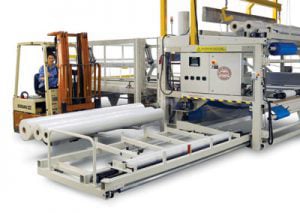
Mattress Packaging Machines: Efficient Packing for Modern Mattress Production
Packaging is the final stage of mattress manufacturing, but it can have a significant influence on everything that happens after a mattress leaves the production line. Mattresses are naturally large products, occupying substantial amounts of warehouse and vehicle space even though much of their volume comes from compressible materials. Modern packaging systems can help manufacturers reduce this volume while protecting finished products during storage and transportation.
Mattress Packaging Machines are designed to automate or simplify processes such as wrapping, compressing, folding and roll packing. The precise equipment required depends on the construction of the mattress and the format in which the manufacturer wants to distribute it. Some mattresses are packaged at approximately their finished dimensions, while suitable foam, pocket-sprung and hybrid constructions may be compressed considerably before being rolled into a compact package.
Reducing package dimensions can provide substantial logistical advantages. A conventional mattress can occupy a large proportion of the available space within a delivery vehicle, container or warehouse. Compression allows more units to be stored or transported within the same physical area, potentially improving distribution efficiency.
Compact packaging has also become important as mattresses are increasingly sold through ecommerce. A compressed and rolled mattress can be considerably easier to handle through distribution networks than a full-size product, although its final dimensions and weight still need to be considered carefully.
Packaging equipment should therefore be viewed as part of the complete production and logistics process rather than simply a machine used to put plastic around the finished product. The chosen packaging method can influence production throughput, warehouse requirements, handling procedures and how the mattress ultimately reaches the customer.
Compression and Roll Packing
Compression is one of the key processes used in modern mattress packaging. The mattress is placed within suitable protective material and subjected to controlled pressure to reduce its thickness. The compressed product can then be sealed to help maintain its reduced dimensions.
Not every mattress should automatically be subjected to the same level of compression. Internal construction, foam characteristics, spring systems and other materials determine how a product responds to pressure and how effectively it recovers afterwards. Manufacturers therefore need to establish appropriate packaging parameters for each mattress design.
Suitable Mattress Packaging Machines can provide controlled and repeatable compression, helping manufacturers maintain consistent package dimensions across a production run. This repeatability becomes increasingly important when packaged products need to fit predetermined cartons, pallets or transport configurations.
Roll packing can reduce dimensions further. After compression, suitable machinery can roll the mattress into a cylindrical or compact rectangular format, depending on the equipment and packaging process. The resulting package can occupy significantly less space than the mattress in its normal expanded form.
Some production arrangements also incorporate folding before rolling. This can create an even more compact package where the mattress construction permits it. Again, the suitability of this process should be established through product testing rather than assuming every mattress can tolerate the same treatment.
Packaging material has an important role throughout compression. It needs to contain and protect the mattress while withstanding the forces generated during the process. Seals also need to remain secure during subsequent handling, storage and transportation.
Once compressed, damage to the packaging can potentially allow the mattress to begin expanding prematurely. Packaging integrity is therefore important not only for cleanliness and presentation but also for maintaining the intended package dimensions.
Manufacturers can incorporate protective outer packaging after compression and rolling. Depending on the distribution method, this might include additional plastic, bags, cartons or other protective materials designed to withstand the normal conditions encountered through warehousing and delivery.
Automation, Handling and Production Efficiency
Packaging equipment needs to operate at a rate compatible with the rest of the mattress production line. Installing machinery capable of extremely rapid compression provides limited benefit if completed mattresses reach the packaging area much more slowly. Conversely, insufficient packaging capacity can create a bottleneck where finished products accumulate while waiting to be processed.
Manufacturers should therefore consider realistic hourly or shift production rather than focusing exclusively on a machine's theoretical maximum speed. Changeover requirements also matter where different mattress sizes and constructions are packaged on the same equipment.
A factory may produce single, double, king and super king mattresses alongside several product depths. Packaging machinery needs to accommodate the relevant dimensional range, while adjustment between products should ideally be straightforward enough to avoid excessive downtime.
Automation can reduce some of the manual handling involved. Finished mattresses are bulky and can be relatively heavy, making repeated lifting and repositioning physically demanding for production employees. Conveyors, powered tables and automated transfer systems can help move products between final assembly and packaging operations.
Once mattresses have been compressed, they become smaller but not necessarily significantly lighter. Handling systems therefore still need to account for package weight. The reduced dimensions simply make the product easier to store and potentially easier to manoeuvre.
Automated sealing and cutting can further streamline production. Rather than manually preparing packaging for every mattress, machinery can control sections of the wrapping and sealing process to produce more consistent results.
Labelling can then be incorporated into the packaging workflow. Mattress factories frequently produce products that look very similar once compressed and wrapped, despite containing different internal constructions or firmness specifications. Clear product identification helps prevent incorrect items entering distribution.
Barcodes or other identification methods can also support traceability. Manufacturers can potentially connect the packaged product with production information, allowing batches and specifications to be identified later if necessary.
Quality control should take place before the mattress is compressed. Once the product has been tightly packaged, inspecting stitching, surface condition and construction becomes considerably more difficult. Detecting a manufacturing defect after packaging can require the product to be opened and potentially repackaged.
Final inspection can therefore confirm the correct mattress specification, dimensions and visible condition before packaging begins. Packaging itself should then be checked for secure seals and obvious damage.
The storage period following compression also deserves consideration. Manufacturers should establish how long their particular products can remain compressed without adversely affecting recovery or performance. This depends on the mattress construction and materials rather than there being one universal period suitable for every product.
Testing is consequently important when developing a compressed mattress range. Manufacturers can package sample products under representative conditions, store them for defined periods and then evaluate how successfully they recover after opening.
Transport testing can add another layer of assurance. Packaged mattresses may experience vibration, stacking, impacts and temperature changes while moving through distribution networks. Packaging should be capable of protecting the product under the reasonably expected conditions of delivery.
Maintenance requirements for Mattress Packaging Machines vary according to the technology involved. Compression equipment can contain hydraulic, pneumatic, mechanical and electrical systems, while roll-packing machinery may include motors, belts, rollers, sensors and automated controls.
Regular inspection can identify wear before it results in an unexpected stoppage. Moving components, sealing systems and safety mechanisms should be maintained according to manufacturer recommendations, while the packaging area should be kept clear of waste material that could interfere with machinery.
Production-critical spare parts may also be worth identifying. If the entire factory depends on one packaging line, a relatively small component failure can prevent finished mattresses from being prepared for dispatch even though manufacturing itself continues normally.
Planned maintenance can therefore be scheduled around production requirements. Operators should also be trained to recognise abnormal noises, inconsistent compression, sealing problems or other changes that could indicate developing equipment issues.
Safety is especially important because mattress compression involves substantial forces. Guards, sensors, interlocks and emergency-stop systems should remain operational, and employees should follow appropriate procedures when clearing faults or performing maintenance.
The packaging materials themselves are becoming an increasingly important consideration. Manufacturers may look for ways to reduce unnecessary material use while still providing sufficient protection throughout distribution. The objective should be to optimise packaging rather than simply minimise it, as inadequate protection can result in damaged products and additional waste.
Package dimensions can similarly be optimised around logistics. Manufacturers can analyse how individual units fit onto pallets, within warehouse locations or inside delivery vehicles. Small changes in finished package dimensions can sometimes allow substantially more products to be transported within a given space.
This demonstrates how packaging decisions can influence costs well beyond the production department. Equipment investment can potentially affect storage density, transport utilisation, handling and ecommerce distribution.
Ultimately, Mattress Packaging Machines provide manufacturers with a way to transform bulky finished mattresses into more manageable packages ready for storage and distribution. Compression, rolling, wrapping and sealing equipment can improve consistency and reduce product volume, while automation can support higher production levels and reduce repetitive handling. Selecting machinery around mattress construction, output requirements and distribution methods can help create a more efficient transition from manufacturing to delivery.